Thursday, September 30, 2010

Community


I don't think I have talked about it before on this blog, but here it is-- I love "Community." It's a show about a study group at Greendale Community College, composed of an ex-narcotics addict, a former high school football star, a single mom, a high school drop out, a falafel restaurant heir, an elderly kook, and a former lawyer, along with reoccurring supporting characters (Star-Burns, Senor Chang, etc.). The show chronicles their time at Greendale and all the TV-sitcom situations that they encounter.

The first season won me over with its quick banter, dialogue infused with pop culture references and sharp humor that I haven't seen rivaled anywhere save the late "Arrested Development." The show marvels in taboos and goes where most shows try but fail due to lack of comedic respect. With "Community," the characters are so funny that they know they're funny, something most shows don't allow their characters. And "Community" even references that it itself is a TV show, but only subtly. The script is unusually smart.

On a side note, I think the study group room has the potential to become a iconic location like that of the Cheers bar or Monk's Restaurant from Seinfeld.

All this to say, I have officially become a regular fan of a show, something that I have never done. I make sure that on Thursdays at 7pm central time, I am in front of a TV. Before, I have only watched shows on DVD. But this time, I feel like I'm mentally investing, I'm allowing myself to be part of a pop culture experiment. I have realized that I come to the TV set expecting to laugh, a high expectation for me, seeing as I rarely truly laugh at anything. But I find myself squealing with joy frequently. And hard. Which brings me to the Season 2 premiere.

Like I said, expectations were high for the Season 2 premiere. It would be the first episode I watched when it originally aired, linked with all the other "Community" fans watching at the same time. I told all my friends in the dorm that they had to watch it, that it was so funny, and we were all in Drew's dorm around the TV. But as we watched (and I was annoyed over and over by commercials), I saw that the writers were trying too hard. The quick banter was gone, and too much stuff was happening. Granted, they did have to deal with Brita's confession of love to Jeff, and his escape into the arms of Annie. But the fake wedding? Come on. That would be something that "Community" would make fun of if it were on another show. And I didn't like the move to Anthropology class, even with Betty White as the teacher. It felt forced, not to mention the cute bow tied on top of the episode's theme that was overtly spelled out. Come on Dan Harmon.

Suffice it to say, I was disappointed. But I still tuned in today (Thursday) for the second episode of the season. And my hope was restored. I saw that the dialogue was snappy again, full of esoteric references that I understood sometimes and others not, but I laughed at all of them anyway because I knew they were references. The jokes were fresh, and the actors seemed to find their characters again. My favorite line was (surprisingly) Peirce's attempt to make a gay joke about Jeff and his old colleague--"He's got a butt for Jeff's wiener." And after Troy, Annie, and Abed knocked out the janitor of the law firm's building, I laughed harder than I ever have when Troy was freaking out, jumping over the janitor in a severely feminine manner. "Community" had found it's stride again.

I don't know how long I will watch the show. At any hint of lameness, I'm gone faster than a frightened deer. But hopefully, maybe, I'll get to see this show all the way through.

If you want a taste of "Community," here's the best episode of the show so far, "Modern Warfare."

Wednesday, September 29, 2010

Worldview

What is my worldview?

I am white. I am a male. I am rich. I am an American. My home is not broken. I went to a private school. I am a Christian. I have no disabilities.

Being white and male, the two most privileged characteristics that a human could have, I don't know any of the hardships that people with those characteristics have known. I don't know what it was like to be treated less than human by being forced to drink out of different water fountains or go to different schools because of my race. I don't know what it's like to have business people think I do an inferior job because of my gender. I don't know what it's like for people to be suspicious of me when I go through airports. I am on the top looking down, and only now am I realizing that everyone isn't up here with me.

Also, my family is fortunate. First, my parents are still together, and neither of them have any addictions that pervasively affect the family. My dad isn't an alcoholic, my mom doesn't do drugs. We are fine. So I can't relate to people who have to work a full time job to pay for their college because their parents can't or won't pay for it for whatever reason. Furthermore, my dad makes a substantial amount of money. I have always had anything I wanted, any toy or food or clothing item--whatever I desired was within reach. I think this is how passion is lost, being able to have anything. In the book "The Outsiders," a bunch of affluent, white kids make up the gang called the Socs. One Soc tells a rival-gang member that "we're always going and going and going, and never asking where. Did you ever hear of having more than you wanted? So that you couldn't want anything else and then started looking for something else to want? It seems like we're always searching for something to satisfy us, and never finding it." These kids have everything they could ever want, and even that is not enough to satisfy the longing in their hearts. It seems that you lose your desire to live while you pursue the panacea for your discontentment.

Other characteristics of my worldview are my American citizenship and Christian affiliation. Christianity is the religion that most Americans claim as their own, making it the most popular religion in America-- the U2 of religions, one could say. I have never been persecuted for my beliefs, never been rejected on account of my religion on any level. This makes me wonder if it is, then, real Christianity that I am a part of, but I digress.

Furthermore, I have no physical or mental disabilities. I don't have down syndrome or autism, I'm not deaf or blind, I don't even have allergies. I have never known the pain of routinely taking medicine or receiving treatment for a disease. I don't know the suffering that comes with wanting to be able to participate, but being prohibited by an unearned condition.

Suffice it to say, I am blessed. I am the most privileged type of person in the world. So what do I do now, in trying to bring about change, hope, and relief? Most people rise from within a suffering society and become a voice for their people. My people have virtually no suffering. So I believe I am called to find a group in need and learn from them, joining their suffering and making it my own. I'm not saying I'm going to gouge my eyes out or break both my legs. I'm saying I will learn to empathize with a group whose worldview is one of suffering, such as the deaf community or the homeless community. If I don't have suffering in my life, I must go and find some and give my peace to them in exchange for a bit of suffering.

Tuesday, September 28, 2010

My Old Music

I'm not embarrassed about what music I used to listen to, mainly because of the feelings associated with the songs are so strong that it's hard to hate them. For example, "Then I Did" by Rascal Flatts pulls me back to middle school, for some reason Kristen Atkinson's house when we watched "The Grudge," but I didn't want to watch it, so I ended up in a room with Britney Daniels and some other people I don't remember, watching "Jersey Girl." This whole story was full of crappy movies and music, but the song somehow, for some reason gets to me and makes me nostalgic. Taylor Swift's "Teardrops on my Guitar" reminds me of a time in middle school when I was infatuated with Karlie Hatchett, and this song was her Myspace profile song. Okay, I feel a little shame about this one, but just because of Myspace. I remember wanting to be her boyfriend so badly that it hurt. God, I am embarrassed of who I was then. I hate who I was, namely because I didn't know who I was, I didn't even care for that matter. Acedia about an identity was what I had.

Nevertheless, back then, music affected me more than I think it ever has. I would stop whatever I was doing and sing with these crappy country songs at the top of my lungs. There's something to say for that.

August and Every Album After


Although I have a penchant for following bands that are new, I have been taken by Counting Crows, especially after listening to their debut album, "August and Everything After." Their sound appeals to me, obviously, but it's something more than that. Adam Duritz sings songs that affect me in ways that most other artists don't, or can't. Coupled with the sound of the band, they create an atmosphere that reaches the core of my soul and plops down on a couch. When I hear the first few words "The circus is falling down on its knees," I get sad and excited at the same time. I feel like I know the pain that Duritz sings of, but I don't feel like I know Duritz. I think this is a talented distinction created on their part. However, I feel like Maria is an old friend. Man, she is fascinating.

So, I'm going to give "Recovering the Satellites" a try, even though I've heard that their best is the debut. But I am hopeful. I thought about trying to listen to the album online, but after hearing the first few seconds of "Angels of the Silences," I knew I had to save it for a car ride, the best place to listen to a new album. That's where I listened to "Is This It?", with Drew and Jake alongside me; "Room on Fire" first made it to my ears through the scarlet assassin's speakers; and "August and Everything After" was heard in parts (thanks to Drew's mix), then fully there. All in all, I think listening to an album in a car is an unrivaled experience.

Thinking back, "Is This It?" was magical. That's the only way I can put it. I remember putting it in outside of the Barnes and Noble from which I bought it, and driving into the night with the title track playing. I felt so cool when I listened to it for the first few times. I felt awesome. Their coolness came through the speakers and settled into my bones. To this day, if I want to feel like a badass, I'll play the song "Is This It?" when I'm walking somewhere on campus.

All I'm asking for is another "Round Here" or "Raining in Baltimore." I'm not asking for another "Mr. Jones," because that song can't be matched. Oh, they get close with "Mrs. Potter's Lullaby" and "Hard Candy" and "Hangin Around," but "Mr. Jones" has the optimism of anonymity, the underdog attitude from having no one know about the band. It's wonderful.

If "Recovering The Satellites" goes well, I think the Counting Crows will have me in their grasp for good.

Monday, September 27, 2010

Taxi Driver


I have this pressure to think of "Taxi Driver" profoundly because it is Mihir's favorite film. I think, though, that because it is so old, I'm having trouble appreciating it. I seriously need to work on that.

"Taxi Driver" is the story of Travis Bickle, a war veteran with insomnia who capitalizes on that unfortunate illness by driving taxis during the night. The film shows the grittiness of New York--the hookers, the pimps, the dank streets. The cab drives through steam rising from the manhole covers and splashes into deep puddles of water. This film shows the dark parts of life.

Bickle sees Betsy, a gorgeous activist who is running a politician's campaign in a building with large windows through which Bickle can watch her. Travis is, as Betsy later calls him, "a walking contradiction"--he can simultaneously see Betsy's loneliness and discontent with the people around her, yet he doesn't have enough sense of what is socially acceptable, and takes her to a porno on a date. However, Travis is incredibly insightful. And when a young girl gets into his cab, only to be taken away by her pimp seconds later, he knows he has to do something.

I think the core of this film is found in the third act, in Travis' attempted and actual killings. At first, Travis tries to kill the presidential candidate. My only guess as to why is because earlier in the film, Travis suggests that the city should be cleaned up as he drives the candidate and his advisers to their destination, a chance cab selection. However, the candidate does nothing. So, out of anger, Travis goes and tries to kill him. I have another theory, however. After the porno, Betsy severs any hope of a relationship with Travis, an act that hurts him deeply. After he goes to the campaign headquarters and demands to see her, he is escorted out. Maybe he tries to kill the candidate out of anger towards Betsy, to eliminate the hard work she has put in or whatever. I think the former theory is right, because it has a second part.

After he tries to kill the man who was supposed to clean up the city, Travis decides to take matters into his own hands and do it himself. He is motivated by the enslavement of young Iris (played fearlessly by a young Jodi Foster), a 12 year old prostitute who has known many men and satisfied their abhorrent desires. Travis buys her but doesn't abuse her; instead, he asks her if she wants to escape, if she wants to get out and go to school and be a young girl. She laughs and says she can leave any time she wants, which both she and the audience know isn't true. She tells how her parents don't want her anymore, and if she were to leave she would have no where to go. Prostitution is her inescapable pit.

So for Iris, for himself, Travis blows the shit out of the pimp and his workers. But he does not go unscathed--he is shot and shot just like he does to his enemies. And he ends on the couch, his blood draining from his wounds, and he dies in the presence of Iris and her now-dead captors.

Or does he die? The following scenes show newspaper clippings depicting him as a hero, the taxi drivers in a diner, accepting Travis when before he was awkward and unsocial. The last scene is Travis driving his taxi with Betsy in the backseat, who seems to give him a second chance, due to his heroics. Is she interested in him because he proved to be a good guy, or because he gained celebrity?

Do I like this film? I don't know. Why should I? Because this character is interesting? Eh, he's all right. I think this film resonates with people like Travis Bickle--people unhappy with the way the world is now, people who will take action to change that world, and people with trauma lingering in their minds.

Editorial

I discussed the film with Mihir, and he said the film was not about the killings, that was just what happened. The film was about Bickle's loneliness. And that's why he loves the film, because he can relate to Travis. The film is about Travis' loneliness, and lonely people get that. People who aren't lonely miss it. Like I did.

Sunday, September 26, 2010

Devil


I was home for the weekend. I'm not sure why I came home. It was convenient because Brock was driving back, but I didn't have any desire to go to homecoming, so I don't know why I went. Maybe to see Cassi and Cari and my family. Yeah, I think that's it. Anyway, at the football game, I talked with Weathers about films, and we decided to see "Devil" the next day. I wish we had theaters that charged $4 for the matinee.

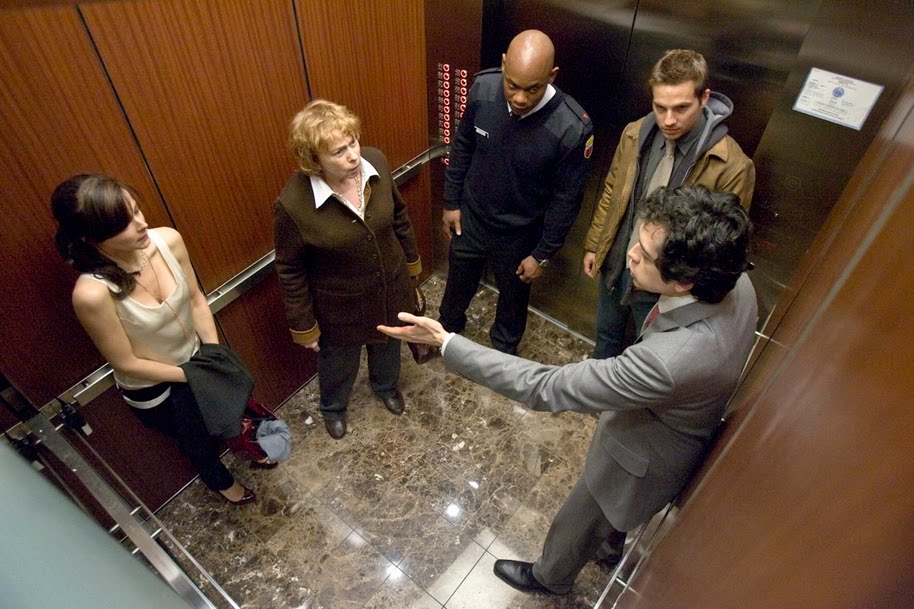
As a whole, I liked the film. I thought the plot was creative and suspenseful (and the film held that suspense the whole way through), the twist was not expected, and the actors took their roles seriously when they could have easily leaned towards caricature. In short, five people get stuck in an elevator, and one is the Devil. We learn that these people have histories of deceit, violence, and theft, and that the devil brought them here to pay for their injustices. This film has several qualities that are similar to the first "Saw" film, but this film is not about pervasive gore and unending torture--this film is about the choices people make and how, even if it seems like you got away with it, there are always consequences.

Tak Fujimoto was the cinematographer for the film, and I am curious as to how he got the shots in the elevator. Did they build a larger elevator, or did they just manage with shooting one person and acting as if everyone else is in the elevator? Also, I thought the point-of-view shots were clues as to who the devil was, but I was mistaken; nevertheless, they were good shots.

I'm undecided as to whether I think this film is too preachy, if this film is up there with "Facing the Giants" and "Fireproof." Although it is a powerful message, it is spoon-fed to the audience. I'm not sure if I like that. Forgiveness is freeing.

Don't be scared, the mother tells her children, because if there is a devil, then that means there must be a God as well. What does this mean? That if bad exists, then we can know that it is bad because we have something that is the exact opposite of it? I just ran through a "what if bad is actually good and we've been wrong the whole time?" argument in my head, but I don't think I want to dive into that.

Overall, I enjoyed this film. It did what it intended, which was to maintain suspense and entertain the audiences. And, if it causes some to think more about the existence of supernatural beings, then it did more than it was supposed to. M. Night, I think your Dark Chronicles are are 1/1.

Saturday, September 25, 2010

A Late Reflection

Choosing to abstain from Facebook and its nuances was the best decision I have ever made for myself, in light of my overly-curious personality and overly-nostalgic heart.

And whenever I'm feeling down, I found that one round of Joan Jett's "Bad Reputation" will cure any blues. At least for a while.